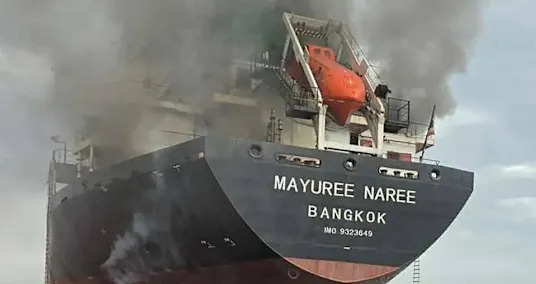

TOPSHOT - This handout photo taken on March 11, 2026 and released by the Royal Thai Navy shows smoke rising from the Thai bulk carrier 'Mayuree Naree' near the Strait of Hormuz after an attack. A Thai bulk carrier travelling in the crucial Strait of Hormuz was attacked March 11, with 20 crew members rescued so far, the Thai navy said. (Photo by Handout / ROYAL THAI NAVY / AFP via Getty Images) / ——-EDITORS NOTE —- RESTRICTED TO EDITORIAL USE - MANDATORY CREDIT "AFP PHOTO / ROYAL THAI NAVY " - NO MARKETING - NO ADVERTISING CAMPAIGNS - DISTRIBUTED AS A SERVICE TO CLIENTS -
ROYAL THAI NAVY/AFP via Getty ImagesOn February 28, 2026, companies sent unexpected emails to their logistics coordinators, instructing them to delay all outbound shipments pending review. Initially believed to be a quality issue or a labor dispute, it was later revealed to be something much more catastrophic. Halfway across the world, airstrikes had just reshaped the Middle East—and within hours, one of the world's most important waterways had effectively closed for business.
Just about 33 kilometers wide at its narrowest point, the Strait of Hormuz handles almost 11% of global maritime trade and a significant part of the world’s automotive supply chain—from the oil that powers logistics networks and the liquefied natural gas that fuels plants, to the components moving between Asia and Europe through the Gulf’s major hubs. Major shipping hubs, such as Jebel Ali Port and Hamad International Airport, located at the crossroads of Asia-Europe trade routes and facilitating the transportation of materials, parts, and finished vehicles, are also expected to be affected.
By late that Saturday evening, traffic through the Strait of Hormuz had decreased by about 70 percent, causing the largest supply disruption in the history of the global oil market, affecting nearly 20 million barrels of crude and products daily. For automotive companies, this means increased costs across the board—a rise in crude prices quickly leads to higher gasoline and diesel prices, which then affect freight rates, factory utilities, plastics, lubricants, and dealer operating expenses—directly changing how the industry behaves. The result: margin compression across the chain.
For many, the Iran conflict is a significant geopolitical event. However, for the automotive sector, it is worse. Analysts have long cautioned against depending too heavily on a single supply route and highlighted the subtle vulnerabilities of just-in-time production. And while the automotive industry struggles with a USD 60+ billion Electric car reset, the conflict will not only cause severe supply chain disruptions but also significant economic consequences.
In a matter of days, the conflict detonated into a macroeconomic shock with direct effects on the automotive industry. My forecasting team at MarketsandMarkets analyzed and identified the industry’s immediate challenges—slower growth in light vehicles, rising fuel and logistics expenses, supply disruptions for components, tighter dealer margins, and a noticeable shift in consumer preferences toward smaller, more fuel-efficient vehicles. What makes this conflict particularly significant is that it affects the industry on multiple fronts simultaneously, impacting energy, supply chains, pricing, and demand and most of these will have medium - long term impact.
LATEST POSTS
- 1
 Interoceanic Train derails in southern Mexico, injuring at least 15 and halting traffic on line
 - 2Rescuers give up hope for the humpback whale stranded in the Baltic Sea
- 36 Arranging Administrations to Change Your Open air Space
- 46 Exercises to Anticipate in 2024
- 5US FDA approves Kura-Kyowa's blood cancer therapy


- European nations criticise Israel’s death penalty plans
- Iran steps up executions as experts warn state killing being used to suppress political dissent
- Many European nations want Israel to cancel 19 new settlement plans
- Vagus nerve stimulation shows promise as a way to counter Alzheimer’s disease- and age-related memory loss
- Eight arrested in joint Scotland and Spain gang raids
- Dave Coulier reveals he has tongue cancer, his 2nd diagnosis in a year, after beating non-Hodgkin lymphoma
- Iranian-linked drone attack kills Kurdish couple in northern Iraq
- How to watch 'A Charlie Brown Christmas' for free in 2025
- What to know about voluntary chocolate recall