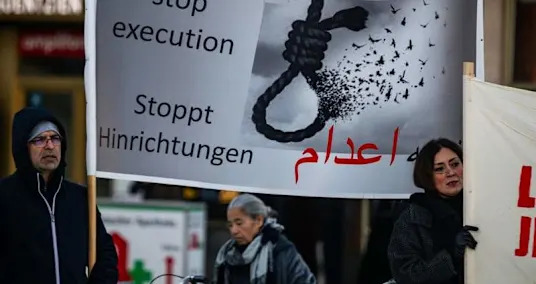
Two of those executed on Monday were killed without advance notice, denying them the chance to meet with their lawyers or say goodbye to their families, according to Amnesty International.
Iran executed two men tied to the People’s Mojahedin Organisation of Iran (PMOI), adding to two other men who were executed on Monday, the group said on Tuesday, confirming a report by Iran’s judiciary news outlet.
PMOI members, 34-year-old law school graduate Babak Alipour and 33-year-old electrical engineer Pouya Ghobadi, were killed on Monday after being convicted of links to the outlawed group and for alleged involvement in multiple attacks, including firing launcher weapons at a government building, according to the judiciary outlet.
Akbar Daneshvarkar, 60, and Mohammad Taghavi-Sangdehi, 59, were also hanged on Monday for alleged membership in Mujahideen-e-Khalq.
Daneshvarkar and Sangdehi were killed without advance notice, denying them the chance to meet with their lawyers or say goodbye to their families, according to Amnesty International.

Abolhassan Montazer and Vahid Bani Amerian, who were tried in the same case, are at imminent risk of death, and communication with the men has so far been impossible to establish, the NGO warned, adding that sources indicated all were subjected to torture during their detention.
“They were chivalrous men who did not bow to any torture or pressure and stood firm on their pledge and covenant until the very end,” Maryam Rajavi, president-elect of the Paris-based National Council of Resistance of Iran (NCRI), the political arm of the PMOI, said in a statement confirming the executions.
She said a number of PMOI members and other political prisoners remained on death row and called for international action to be taken to save their lives.
People’s Mojahedin Organisation banned in Iran
The NCRI, also known as PMOI, is banned in Iran, and it is unclear how much support it has there. However, along with its bitter rival – the monarchists backing Reza Pahlavi, exiled son of the toppled Shah – it is one of the few opposition groups able to rally supporters.
United Nations Special Rapporteur on human rights in Iran warned on Tuesday that, while the internet shutdown had made it difficult to monitor executions, it was “clear” the regime is using executions as “a means of suppressing political dissent amid war.”
United Nations Special Rapporteur on Human Rights and Counter Terrorism Professor Ben Saul added that he also condemned “Iran’s misuse of the death penalty in alleged security cases in violation of the right to life.”
LATEST POSTS
- 1
 France to build new nuclear aircraft carrier, Macron says
 - 29 African migrants died in freezing temperatures near Morocco-Algeria border
- 3Figure out How to Get the Best Open Record Rewards
- 4Hilary Duff releases 'Mature,' her 1st song in 10 years
- 5Jamaica reports deadly leptospirosis outbreak after Hurricane Melissa


- Find the Standards of Powerful Cooperation: Accomplishing Cooperative energy and Coordinated effort
- 100 new alien worlds: Scientists find hidden haul in data from NASA exoplanet-hunting spacecraft
- Ford Is Using a Chinese-Built Van to Fight Europe’s EV Price War
- Fossils unearthed in Morocco are first from little-understood period of human evolution
- Iran plans new restrictions in overhaul of Strait of Hormuz rules
- The Oscars are moving from ABC to YouTube starting in 2029
- Fascinating Fishing Objections From Around The World
- Cruising Solo All over the Planet: An Excursion of Self-Disclosure
- Seoul says sorry after unapproved drone flights into North Korea