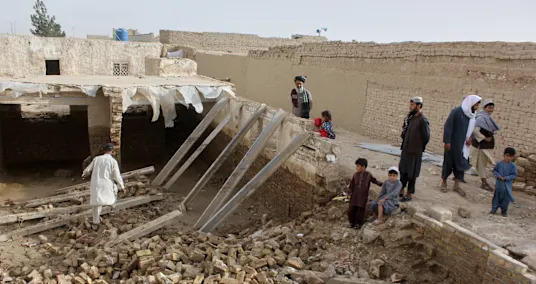
Heavy rain that has caused severe flooding and landslides has killed at least 45 people in Afghanistan and Pakistan over the past five days, authorities say.
Afghanistan’s National Disaster Management Authority (ANDMA) said on Monday that 28 people have been killed in the floods and 49 injured with more than 100 homes destroyed.
Most of the deaths in Afghanistan were reported in central and eastern provinces, including Parwan, Maidan Wardak, Daikundi and Logar, according to ANDMA.
The authority added in a statement that weather conditions remained “unstable” in parts of the country and there is a continued risk of more rain and flooding in some areas.
“In total, 1,140 families have been affected,” ANDMA said.
Police spokesperson Sediqullah Seddiqi told the AFP news agency a 14-year-old boy died after being struck by lightning in the northwestern province of Badghis.
He added that in the same province, three people had drowned while trying to gather driftwood to be used for heating.
At the same time in Pakistan’s Khyber Pakhtunkhwa province, which shares a border with Afghanistan, 17 people were killed and 56 wounded, the Provincial Disaster Management Authority said.

Extreme weather
Heavy rainfall has continued to sweep across Afghanistan since Thursday, causing floods and landslides in multiple provinces.
The weather prompted the closure of several highways, according to officials in central and eastern Afghanistan. Further rains and storms are forecast for Tuesday.
Afghanistan’s National Disaster Management Authority has warned citizens to refrain from using “rivers and flooded streams, and follow the weather forecast seriously”.
In the central province of Daikundi, the local disaster management department said a five-year-old was killed when a roof collapsed. A woman was also killed in the same circumstances in the eastern province of Nangarhar, police spokesperson Sayed Tayeb Hamad said.
Afghanistan is vulnerable to extreme weather, particularly heavy rainfall and monsoon seasons, which trigger floods and landslides in remote areas with fragile infrastructure.
In January, flash floods and snowfall caused the deaths of at least 17 people and killed livestock.
LATEST POSTS
- 1
 Former 'Bachelorette' welcomes 1st baby via emergency c-section
 - 2Savvy Cleaning: The 6 Robot Vacuums of 2024
- 3Data centers in space: Will 2027 really be the year AI goes to orbit?
- 4Cells have more mini ‘organs’ than researchers thought − unbound by membranes, these rogue organelles challenge biology’s fundamentals
- 5Christmas 2025 skywatching guide: What you can see in the night sky on Dec. 25


- Vote in favor of your Number one Kind of Gems
- Going on a bad date is a drag. Worse? Ending up as a cautionary tale on TikTok.
- The newest 'Project Hail Mary' trailer shows Ryan Gosling befriending an alien in Phil Lord and Chris Miller's space epic
- Top 15 Supportable Design Brands Coming out on top
- Help Your Insusceptibility: Good dieting and Way of life Tips
- Brazilian cardinal orders a popular Catholic priest to go offline following right-wing attacks
- Conquering Social Generalizations: Individual Accounts of Strengthening
- This is Countdown, CNN’s newsletter covering NASA’s first time sending humans to deep space in over 50 years
- Dental Embed Innovation: An Achievement in Helpful Dentistry