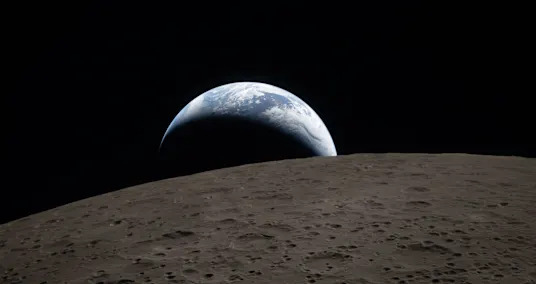
HOUSTON (AP) — The Artemis II astronauts are now forever intertwined with Apollo 8.
A day after the historic lunar flyaround, NASA on Tuesday released striking new photos taken by the U.S.-Canadian crew.
The four astronauts channeled Apollo 8’s famous Earthrise shot from 1968 with their own: Earthset, showing our planet setting behind the gray, pockmarked moon. Another photo captures the total solar eclipse that occurred when the moon blocked the sun from the crew’s perspective.
The three Americans and one Canadian are now headed home, with a splashdown in the Pacific set for Friday. In the meantime, scientists at Houston's Mission Control are poring over the stream of moon photos beaming down.
Apollo 8's three astronauts became the world's first lunar visitors, orbiting the moon on Christmas Eve 1968. Their Earthrise shot became a symbol of the modern-day environmental movement.
Artemis II marks NASA's first return to the moon with astronauts — a critical step toward a lunar landing by another crew in two years.
___
The Associated Press Health and Science Department receives support from the Howard Hughes Medical Institute’s Department of Science Education and the Robert Wood Johnson Foundation. The AP is solely responsible for all content.
LATEST POSTS
- 1
 Six Flags Opens the Tallest, Fastest and Longest Roller Coaster in the World
 - 2Is Iran using cryptocurrencies to circumvent sanctions?
- 3A Manual for Nations with Extraordinary Food
- 4Striking American and European television Projects: A Survey
- 5RFK Jr. succeeds in changing hepatitis B recommendation | The Excerpt




- This is Countdown, CNN’s newsletter covering NASA’s first time sending humans to deep space in over 50 years
- Vice President Dick Cheney’s life followed the arc of the biggest breakthroughs in cardiovascular medicine
- Israeli lawmakers pass bill reviving death penalty for terrorists
- 5 Home EV Chargers for Proficient and Solid Charging
- Holiday spots Well known With Americans In 2024
- Vote in favor of your Number one method for commending a birthday
- South African army arrive in crime hotspots to help tackle gangs
- Canada's Friendly Sunshine Coast City Is An Outdoor Playground Perfect For Hiking And Paddling
- CMA Awards 2025: Full list of nominations, from Entertainer of the Year to Album of the Year