Protests took place in Tel Aviv, Jerusalem, Haifa, and Beersheba, as a survey found broad but uneven support among Jewish Israelis for Operation Roaring Lion.
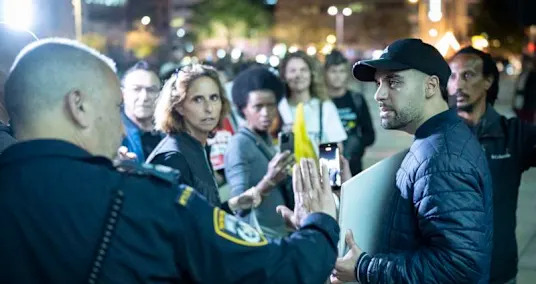
Israel Police arrested 21 anti-war protesters Saturday night as demonstrations against the conflict with Iran expanded in multiple cities despite restrictions on public gatherings.
Protests took place in Tel Aviv, Jerusalem, Haifa, and Beersheba, with hundreds of participants reported in Tel Aviv and Jerusalem and about 100 in Haifa, marking the largest turnout since weekly demonstrations began. Authorities said 13 people were arrested in Tel Aviv and eight in Haifa.
Police said the gatherings were not approved under Home Front Command regulations that ban events with more than 50 people. Officials said the increase in turnout followed calls by groups opposing the government to protest despite the restrictions.
“During a situation assessment that took place at the scene with a Home Front Command representative… it was clarified that there was a real risk to human life and accordingly, Yarkon [precinct] police commander Tzachi Sharabi ordered the gathering to be dispersed,” police said.
Hadash-Ta’al chairman Ayman Odeh, an Arab lawmaker involved in the protests, criticized the police response, calling officers fascists “in the service of the government” and saying they were afraid of “the heroic citizens who went out, despite everything, to make their voice heard.”

Survey shows broad, uneven support for war
The demonstrations come as a March 2026 survey by the Israel Democracy Institute found broad but uneven support among Jewish Israelis for Operation Roaring Lion. Support was strongest on the Right at 87% and about half on the Left.
The survey also found that Jewish and Arab respondents largely agreed that Iran’s resilience has been stronger than expected. Most Jewish respondents said Israeli society could sustain the campaign for up to one month, while 28% said as long as needed. Arab respondents were less optimistic about how long the public could endure the conflict.
A majority of Jewish respondents said Prime Minister Benjamin Netanyahu’s decision was driven by security considerations, while most Arab respondents viewed it as political.
LATEST POSTS
- 1
 Euclid space telescope sees gorgeous cosmic cloud | Space photo of the day for Nov. 18, 2025
 - 2Instructions to Choose the Best Material Organization for a Fruitful Rooftop Substitution
- 3China Just Got Another Cheap EV America Would Love to Have
- 4These HGTV stars made a pledge to keep their kids off smartphones. Here's how it's going.
- 5I visited every country by 25. Antarctica showed me how much I still hadn't seen.





- Russia earning billions from Hormuz blockade, German trade body says
- Virtual reality opens doors for older people to build closer connections in real life
- Cocoa Prices Sink on Favorable Crop Conditions in West Africa
- Excited visitors for NASA's moon launch jockey for prime views
- Climate engineering would alter the oceans, reshaping marine life – our new study examines each method’s risks
- Careful Connections: Building Association and Trust
- Factbox-Weight-loss drug developers line up to tap lucrative market as competition heats up
- Heavenly Pastry Confrontation: Pick Your #1 Sweet Treat!
- Vote in favor of your #1 Kind of Cap